
For many condominiums, the collective EPC is still seen as just another obligation: a document to be produced, filed, and presented at the general meeting. However, when properly utilized, it is one of the most powerful levers for managing a building’s value, occupant comfort, and service charges, without necessarily committing to heavy works in the first year. Here is the method to improve your condominium’s EPC rating step by step, starting with high-impact actions and a controlled budget.
The collective EPC, much more than a regulatory obligation
With the gradual rollout of the Climate and Resilience Law, the timeline is tightening for condominiums. Properties rated G are already banned from the rental market, F-rated ones will be in 2028, and E-rated ones in 2034. For buildings with an F or G rating—the “energy-inefficient properties”—the pressure is twofold: the risk of lost rental income for landlords and spiraling heating costs for owner-occupiers.
But the collective condominium EPC is not just a compliance document. It is also:
- a quantified snapshot of the building’s consumption and emissions,
- the baseline for measuring the impact of every action taken,
- the foundation that feeds the Multi-Year Works Plan (PPT).
Provided it is used actively, rather than just being endured.
Improving the EPC rating: starting with “low budget, high impact” actions
What surprises most supervisory boards is that it is often possible to save several percentage points in heating consumption, and sometimes gain an entire rating, without breaking a single wall. Before external wall insulation or replacing the collective boiler, several targeted interventions deserve consideration.
A More Intuitive Reading of Energy Data
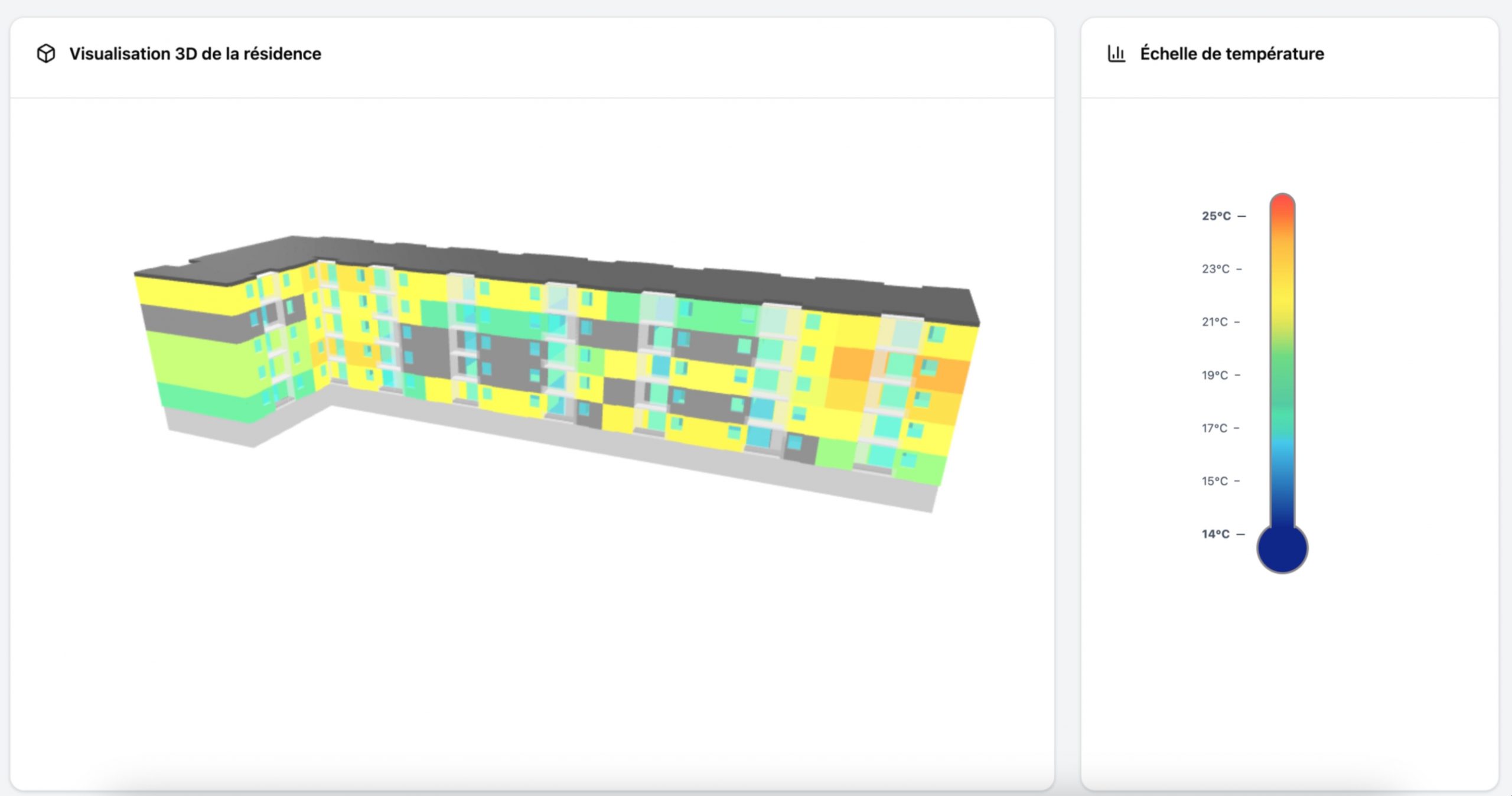
To facilitate interpretation, dwellings are colored according to their temperature. A color code ranging from blue to red allows for immediate identification of colder or warmer areas within the building.
This spatial representation transforms the way energy data is observed. Where analysis traditionally relied on tables or graphs, KOCLIKO 3D now allows for the direct visualization of information within the building’s structure. Data thus becomes much simpler to understand and analyze.
Sludge removal from the heating network
Over the years, sludge (corrosion residues, mineral deposits) accumulates in pipes and radiators. As a result, heat transfer is poor, some radiators remain lukewarm, and the boiler works unnecessarily hard. Collective heating sludge removal, supplemented by a corrosion inhibitor, can generate 5% to 15% in heating savings, without any intervention inside the apartments.
Hydraulic balancing of networks
When some apartments overheat while others stay cold, it is often a balancing issue. Adjusting the flow rates of each column or outlet improves comfort and reduces consumption, generally by 10% to 15%.
Management and regulation of collective heating
Outdoor sensors, programmers, adapted heating curves, and thermostatic valves in apartments: these are all levers that can save 5% to 20% depending on the initial situation. Often, the return on investment is less than three years.
Lagging of pipes in common areas
Heating and domestic hot water pipes passing through cellars and technical rooms often radiate heat into empty space. Lagging them (insulating them with shells or sleeves) limits these losses—a modest investment that pays for itself in less than two years in most cases.
Combined, these actions allow many condominiums to gain an EPC rating or prepare the ground before more structural insulation or system change projects.
The real challenge: prioritizing the right works
The classic trap in condominiums is the opposite of inaction: committing significant expenditure to areas that do not account for the most consumption, or without having measured the real potential for gain.
Three questions should guide every decision:
- Which area consumes the most in the building (heating, DHW, ventilation, building envelope)?
- Which works scenario provides the best cost / energy gain / rating jump ratio?
- How to measure the real impact once the works are completed, to validate the trajectory and adjust?
This is precisely where a decision-support tool changes the game.
Kocliko: generating the collective EPC and managing its improvement roadmap
Kocliko is not limited to the regulatory generation of the collective EPC. The solution supports condominiums throughout their energy roadmap with four complementary modules.
3D Building Modeling
Each building is rendered as a detailed 3D model that allows for the concrete visualization of the envelope, heat loss, and critical zones. Much more meaningful than an Excel spreadsheet for a supervisory board or a general meeting.
Based on the model, Kocliko generates several quantified scenarios: attic insulation, EWI, window replacement, system replacement, or combinations. For each scenario, you can view the projected EPC rating, the estimated energy savings, the budget, and the carbon trajectory.
Based on the model, Kocliko generates several costed scenarios: attic insulation, external wall insulation (EWI), window and door replacement, system replacement, or combinations. For each scenario, you can view the projected EPC rating, the estimated energy savings, the budget and the carbon trajectory.
Digital twin updated retrospectively
Once the works are completed, the building’s digital twin is updated: it reflects the reality of the property, not the original theoretical version. A key point for condominiums that carry out their operations in phases over several years.
Real-time and continuous impact measurement
Real energy data (consumption, temperatures, equipment operation) is integrated to measure the effect of actions as they happen. No more waiting for the annual bill to know if an intervention has paid off.
Building your condominium’s EPC roadmap
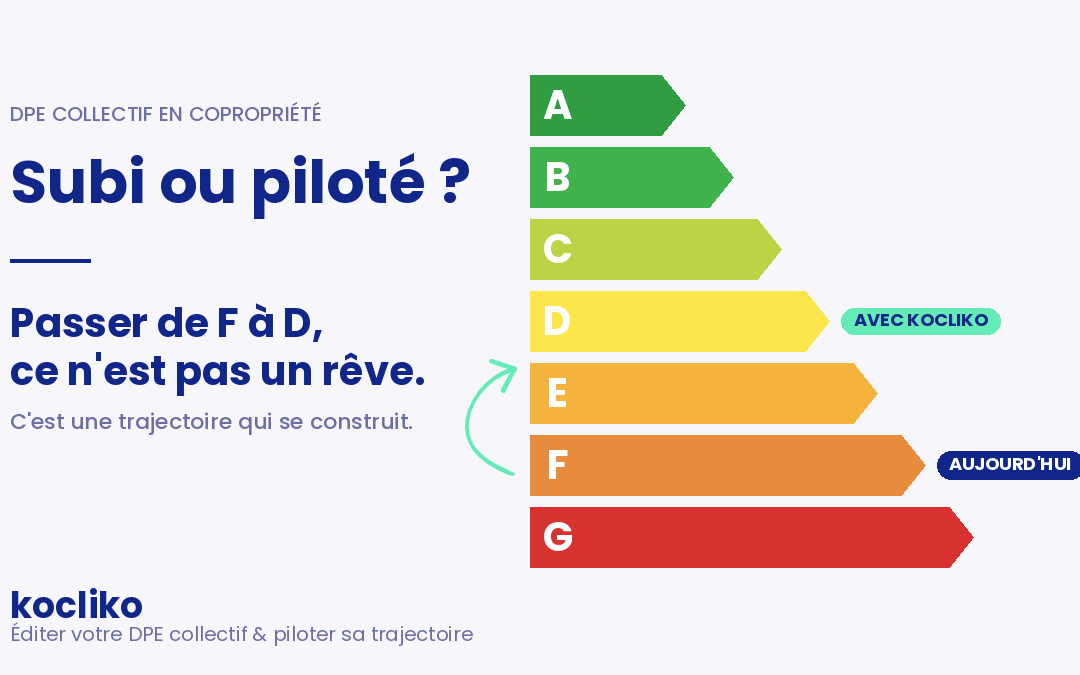
Moving from F to D, or even F to C, is not a dream. It is a roadmap that is built by intelligently layering:
- simple and quick actions (sludge removal, balancing, management),
- targeted projects on the areas that truly matter,
- continuous measurement to adjust along the way.
All while keeping two often-perceived contradictory objectives in sight: budget control for the condominium and sustainable energy performance for the building. With the right tools, this equation has a solution.
Would you like to visualize your building’s EPC roadmap? Request a Kocliko demo and discover in just a few minutes the improvement scenarios best suited to your condominium.

Kocliko


Recent Comments