
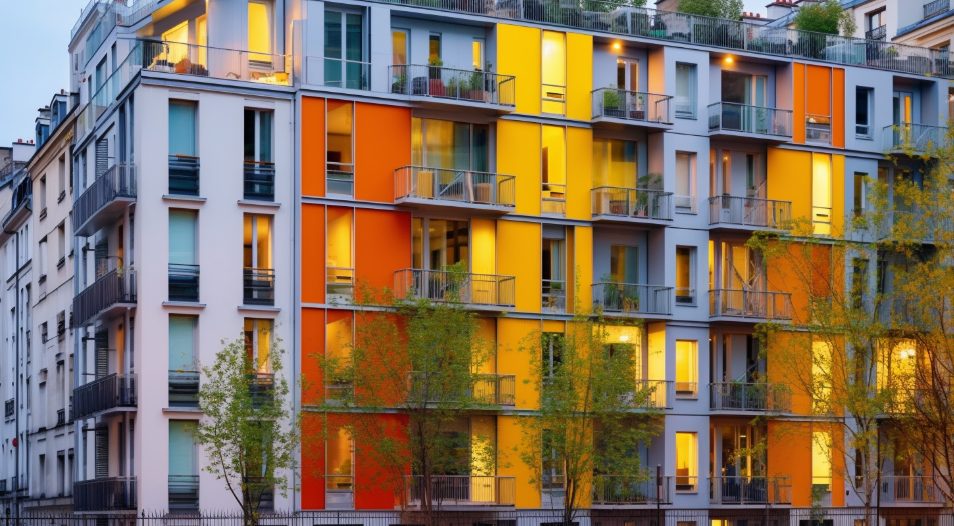
To reach the same indoor temperature, homes consume more or less heating depending on their location within the building (floor, orientation, sunlight exposure, exterior wall surface areas, etc.).
When it comes to allocating heating costs, a home’s location within the building can be a source of controversy, particularly in social housing.
Here are a few excerpts from tenant association statements on the subject:
“In other words, apartments facing due south or due north, surrounded by other apartments (and therefore partly heated by them), or located on the top floor on the gable end will be treated the same way. Such a measure is unfair and will penalize occupants of ‘poorly located’ homes, whose bill could increase by 44%! This is why the CLCV is calling for coefficients to be determined and set in order to take into account homes that are thermally disadvantaged (gable end, north-facing…); (1)
“The CSF reminds us that an “excessive individualization of the allocation of heating costs carries serious risks of unfairness, particularly in the social housing stock. Indeed, when housing is allocated, “the tenant does not choose, for example, to live in a north-facing apartment or on the top floor,” the confederation notes.” (2)
“For the CNL, under the guise of the laudable goal of saving energy, this measure simply calls the principle of solidarity into question. Indeed, sharing the heating bill makes it as fair as possible for residents because it takes into account differences in location and the difficulties in heating that, for example, an occupant of a north-facing ground-floor apartment faces compared with an occupant on the 2nd floor, heated by neighbors and facing due south. This measure will therefore penalize many residents and will very significantly increase their bill.” (3)
“That is to say, a tenant will be required to pay more or less for their heating costs depending on the characteristics of their home, and not on their own energy consumption habits” (4)
“If the objective of the regulations is to establish billing as close as possible to personal consumption, this assumes that the heating system is properly balanced, meaning that all radiators in the building heat evenly (…) Furthermore, the choice of an apartment as part of a purchase or even a rental will be affected depending on the property’s geographic orientation and its floor. A north-facing home located under an uninsulated roof is in fact thermally disadvantaged, and will therefore have to consume more heating to restore the indoor temperature.” (5)
⚖️ KOCLIKO demonstrates that it is possible to individualize heating costs and encourage sobriety, without penalizing poorly located homes!
1. The principle of Individual Heating Cost Allocation
Historically, the amount of a residence’s heating bill (with collective heating) was or used to be allocated pro rata to the floor area of the homes.
Unsurprisingly, this approach does not encourage energy-saving behavior; significant waste is therefore observed.
With this system, the boiler is set for the coldest apartment, and residents of warmer homes are not encouraged to use the thermostatic valves installed on radiators. Why bother? They will pay the same amount.
Individual Heating Cost Allocation (IFC) consists of allocating the bill based on each home’s actual consumption.
Residents are thus directly “rewarded” for their efforts to regulate heating.
II) Homes’ location: a matter of fairness
Depending on their position in the building, some homes consume a lot of heating to be comfortable, while others consume little.
Heat gains and losses depend on the “location”: floor, orientation, sunlight exposure, exterior wall surface areas, etc.

By moving from area-based billing to actual-consumption billing, some homes will benefit and others will be disadvantaged. For fear of being disadvantaged, many residents strongly resist the rollout of IFC. This partly explains why only 30% of the eligible stock is equipped to date.
These fairness issues are a priority in a context of a sharp rise in energy prices and, consequently, growing attention (and tension) around heating charges. Any sense of unfair treatment would be likely to damage relations between residents, and between residents and the property manager.
It is therefore customary to correct for location differences, particularly in social housing since tenants do not choose their home.
In condominiums, the general meeting generally chooses not to correct for location differences. Co-owners consider it normal that a south-facing home (purchased at a higher price) is advantaged when it comes to heating charges.
III) Examples of COSTIC “location coefficients”
A COSTIC guide (Scientific and Technical Committee for the HVAC Industries (6)) from 1991 sets out the principle of “location coefficients” and proposes as an example the summary values below:
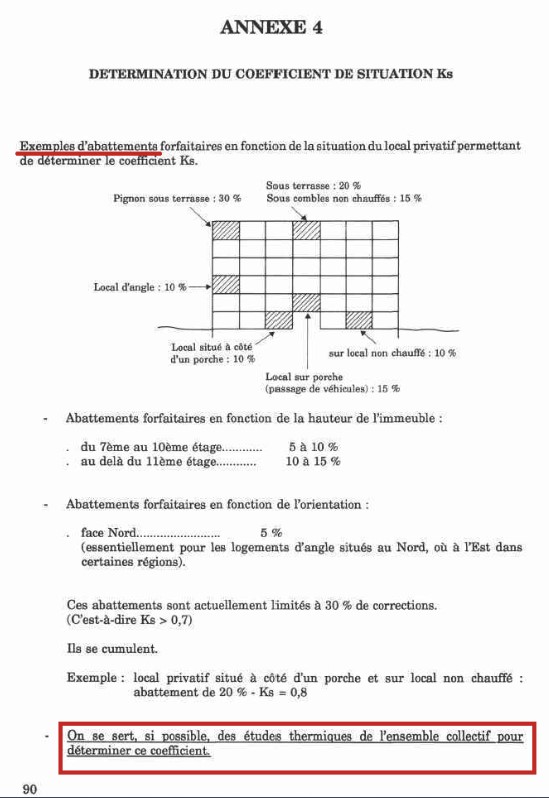
The guide clearly states that “where possible, the collective building’s thermal studies are used to determine the location coefficient”.
With “traditional” Thermal Energy Meters and Heating Cost Allocators (HCA), this thermal study is never carried out because it is too costly.
KOCLIKO is the only provider offering a systematic thermal study to calculate location coefficients.
This study is included “by default” in the new HCA technology that uses indoor temperature measurement in homes and a digital twin of the building.
IV) What difference does the method used to calculate location coefficients make?
So, ultimately, what is the difference between the “COSTIC coefficients” and the coefficients calculated on a bespoke basis for each project using a thermal study?
KOCLIKO compared 441 homes across 25 residences. For these 441 homes, the coefficients were systematically calculated using both methods: the rule provided as an example by COSTIC, and the exact thermal study carried out using the digital twin.
The average error is 18%, which represents an error of €180 on an average heating bill of €1,000.
In some cases, the error reaches 120%, i.e., €1,200 on an average bill of €1,000.
An example to understand
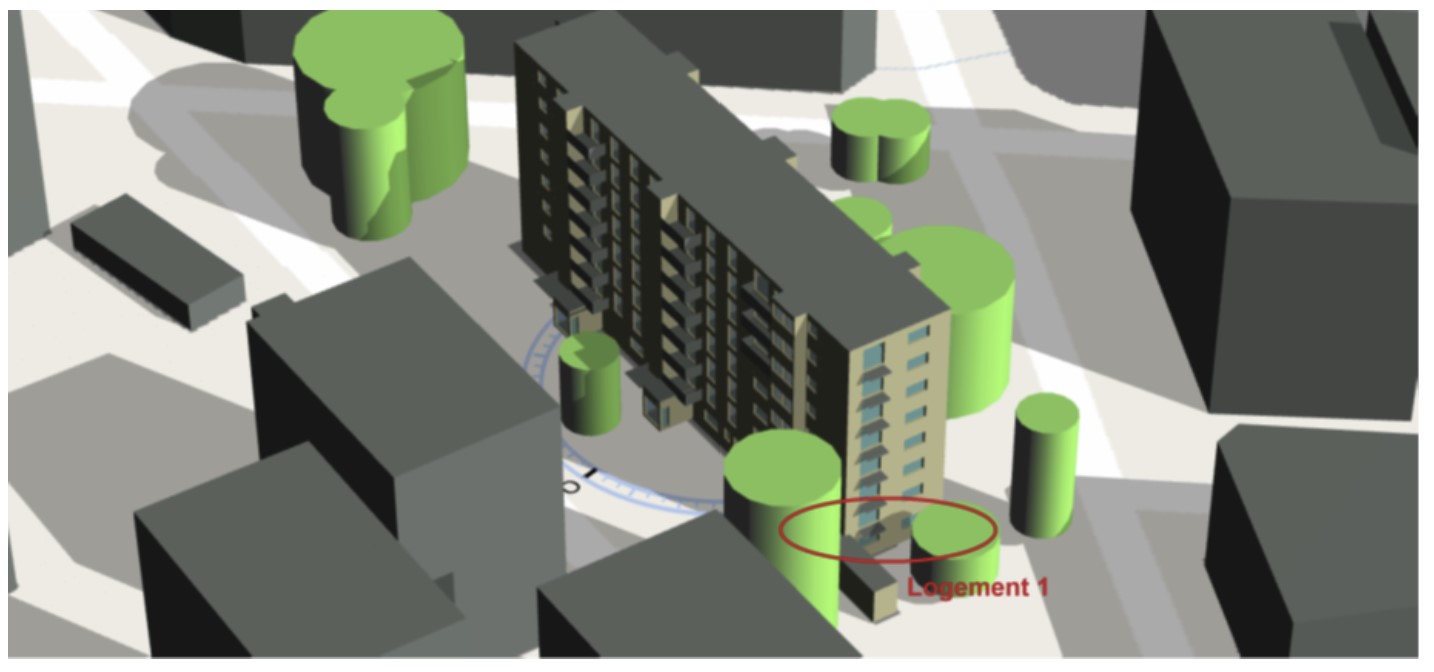
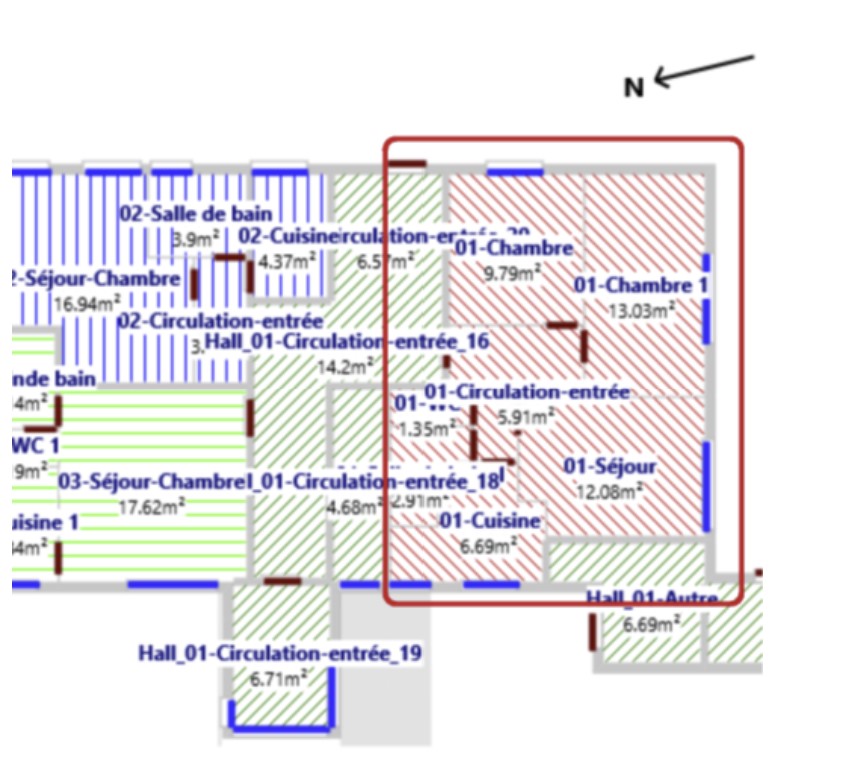
In this very typical and representative residence, the COSTIC coefficient is -7% for home 1. (7)
Explanation:
- Home 1 is on the ground floor on an uninsulated slab. It has much higher heat losses than average.
- A significant portion of its walls is adjacent to an unheated corridor.
- Even though it faces south, being on the ground floor with trees and nearby buildings means it receives little solar gain.
Result:
The COSTIC coefficient is 47% too low. On an individualized share of €1,000, this represents an error of €470!
The resident of this home has a real interest in having the coefficients calculated correctly; otherwise, they will be heavily penalized.
It is also important to be able to justify these values, thanks to a transparent, well-substantiated thermal study, to avoid disputes within the residence.
In the event of works
If works are carried out at the building level, the digital twin is updated and the location coefficients are recalculated.
In our example, insulating the underside of the ground floor slab with 7 cm of insulation brings home 1’s coefficient from 54% down to 20%.
Home 1 benefits from the works, as do the other homes.
A form of “thermal solidarity” is therefore maintained within the building, along with a shared interest in improving it.
COSTIC coefficients, on the other hand, never change. Corrections are assigned “for life”.
Another example to understand (even better)
Case study:
1970 building (according to the specifications of the ABC guide, to be representative of buildings from that era, the target of IFC).
Thermal characteristics:
-
- exterior wall: 20 m concrete
- ground floor (over crawl space) and intermediate floors: 20 cm concrete
- top floor (flat roof): 20 cm concrete + 5 cm exterior insulation (0.040 W/(m.K))
- interior partition: plaster brick
- windows/doors: aluminum single glazing (Uw = 4.7 W/(m².K))
- natural ventilation via air inlets/extraction (0.88 vol/h)
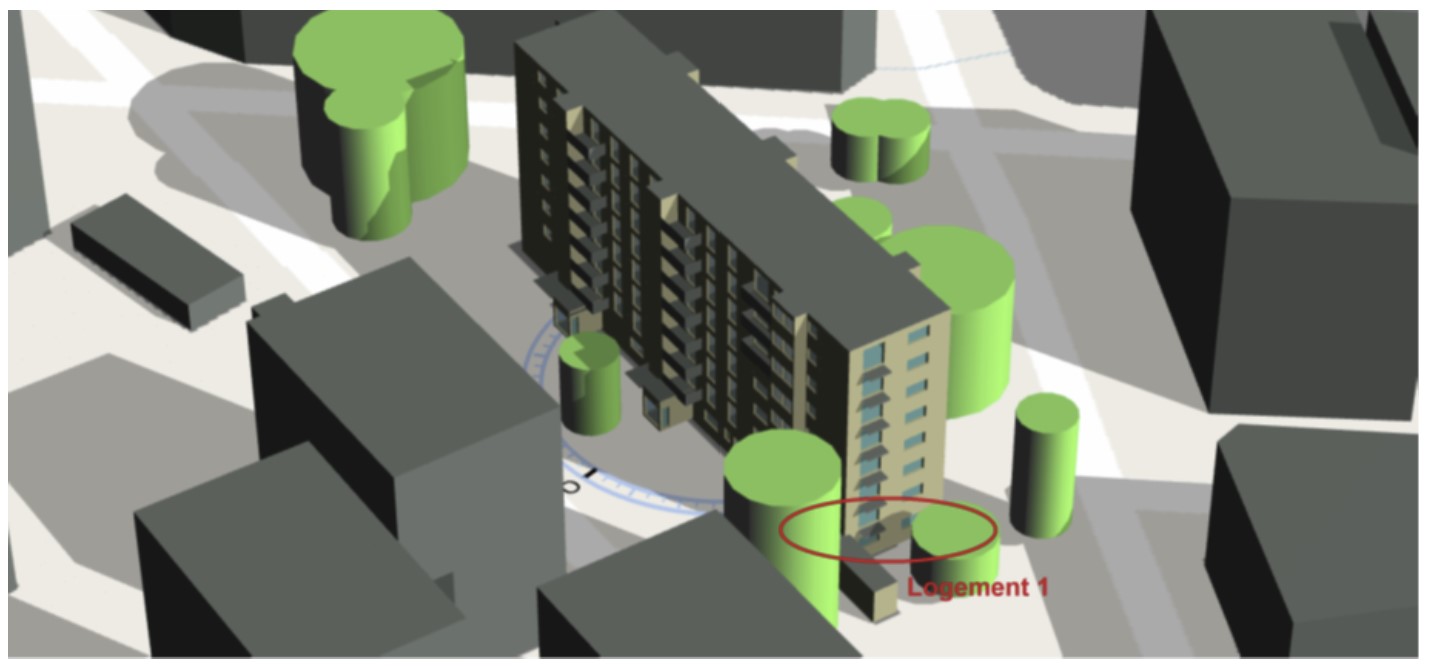
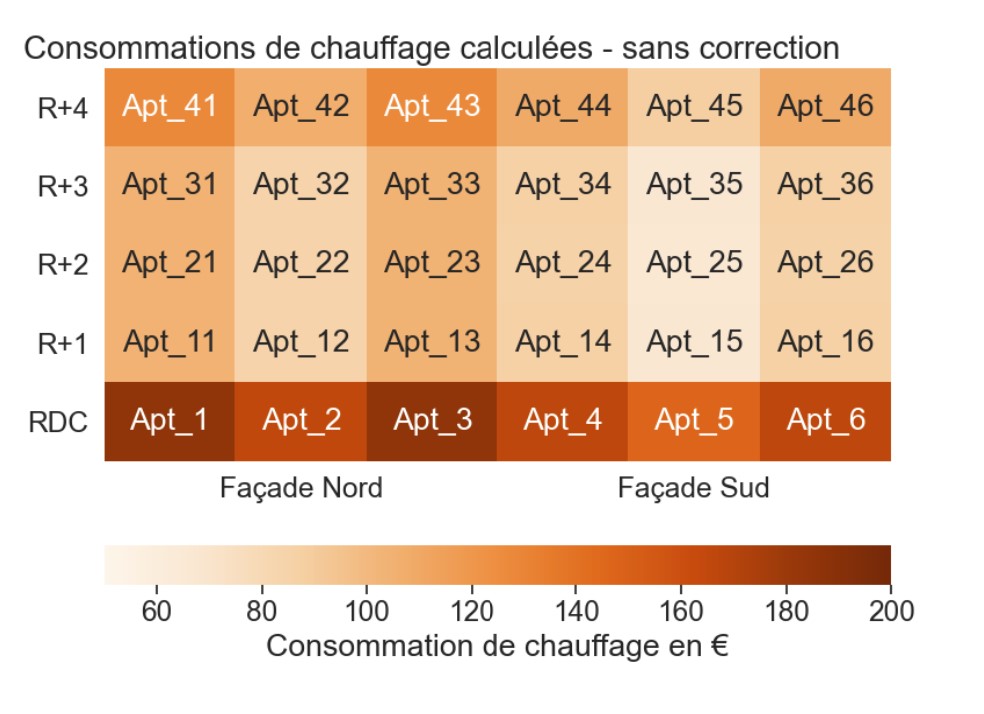
In this simulated residence, all homes have the same floor area and are heated to 19°C for one month (February).
Without correction, bills vary widely (from half to double between the home with the lowest bill and the home with the highest bill), since heat losses vary greatly depending on location.
With correction, we expect homes, with identical usage, to have identical bills.
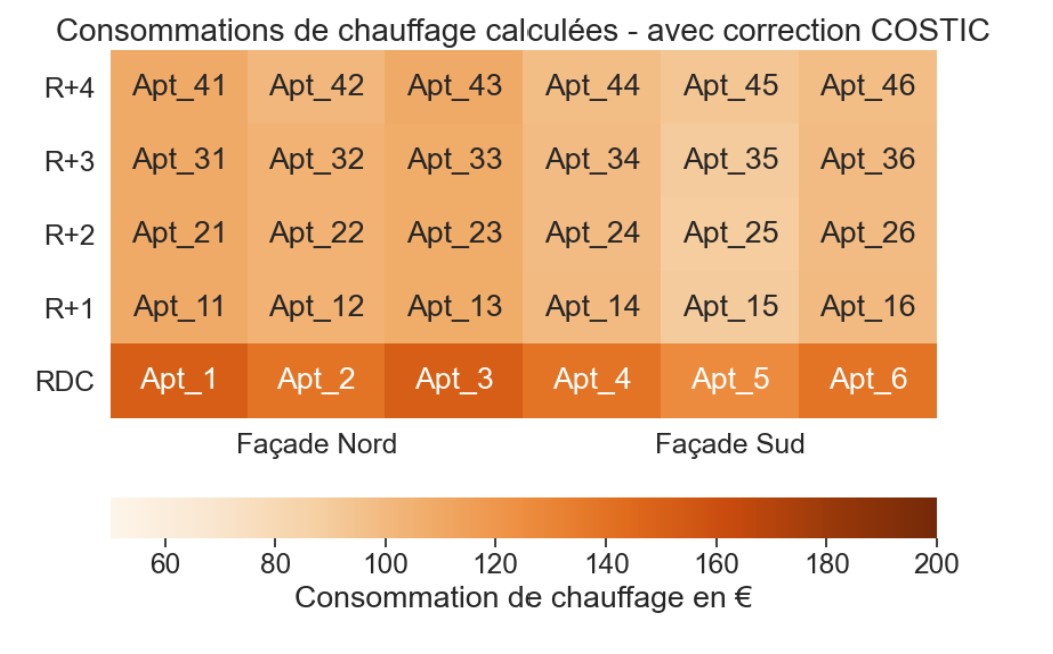
It can be seen that COSTIC coefficients poorly correct location disparities. In this case, the reduction granted is excessive for top-floor homes and largely insufficient for ground-floor homes. The reduction linked to north-facing exposure is also insufficient. With identical usage and floor area, February bills range from €83 to €156.
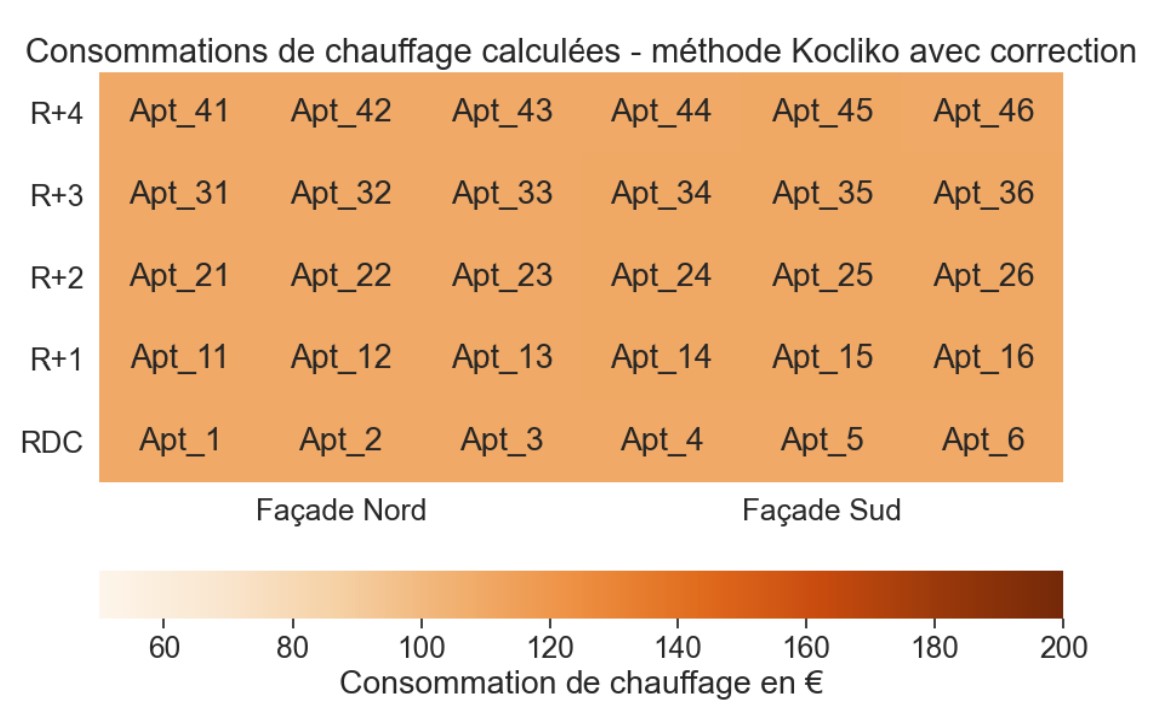
Conversely, bespoke coefficients calculated using the digital twin perfectly correct the disparities. With identical usage and floor area, all homes have a bill of €110.
In summary
Implementing IFC suddenly changes a rule that has always been in place in the residence. Imagine two households occupying two homes of identical floor area, heated to the same temperature. With the shares (tantièmes), they paid the same price, but with IFC their bill may suddenly diverge from half to double, due to their home’s more or less favorable location. This abrupt change in the rule can understandably be difficult to accept—especially for tenants in social housing who do not “choose” their home. Tenant associations have clearly identified this issue, which has been their main objection to IFC.
“Location coefficients” were invented to address this break in fairness by correcting for differences in homes’ locations. COSTIC proposed values for these coefficients, but only as examples, and specified that the correct method was to carry out a thermal study building by building.
This study has never been carried out to date due to its complexity and cost. But the new HCA technology using indoor temperature changes the situation, since a thermal simulation model of the building is systematically produced. Calculating the location coefficients is the natural next step.
When comparing COSTIC location coefficients with those resulting from a genuine thermal study, the differences are considerable. KOCLIKO carried out a comparative analysis of 441 homes across 25 residences. The average error is 18% (€180 on an average heating bill of €1,000), and in some cases it reaches 120% (i.e., €1,200 on an average bill of €1,000).
Correctly calculating location coefficients addresses two challenges. Fairness: tenants pay more or less in charges based on their usage, not based on their location within the building; and transparency: the property manager is able to explain the location coefficients applied, supported by a rigorous thermal study. Given the amounts involved in heating charges, there is no doubt these challenges must be taken seriously.
Sources:
(1) IFC, CLVG, 2016
(2) Individualized heating costs: measuring what will be expensive for tenants, SUD OUEST, 2016
(3) IFC and inequality, LA CNL, 2016
(4) Allocation of heating costs, NATIONAL CONFEDERATION OF HOUSING, 2016
(5). Press release IFC, LA CGL, 2016
(7) Based on the values proposed by COSTIC, the coefficient for this home is calculated as follows: ground floor + corner + south => -10% -10% +5% = -15%. The average for the homes being -8%, this represents a correction of -7%.
(8). Note: If works are carried out by an owner, such as replacing their windows, the savings are theirs alone and the location coefficients are not recalculated.

